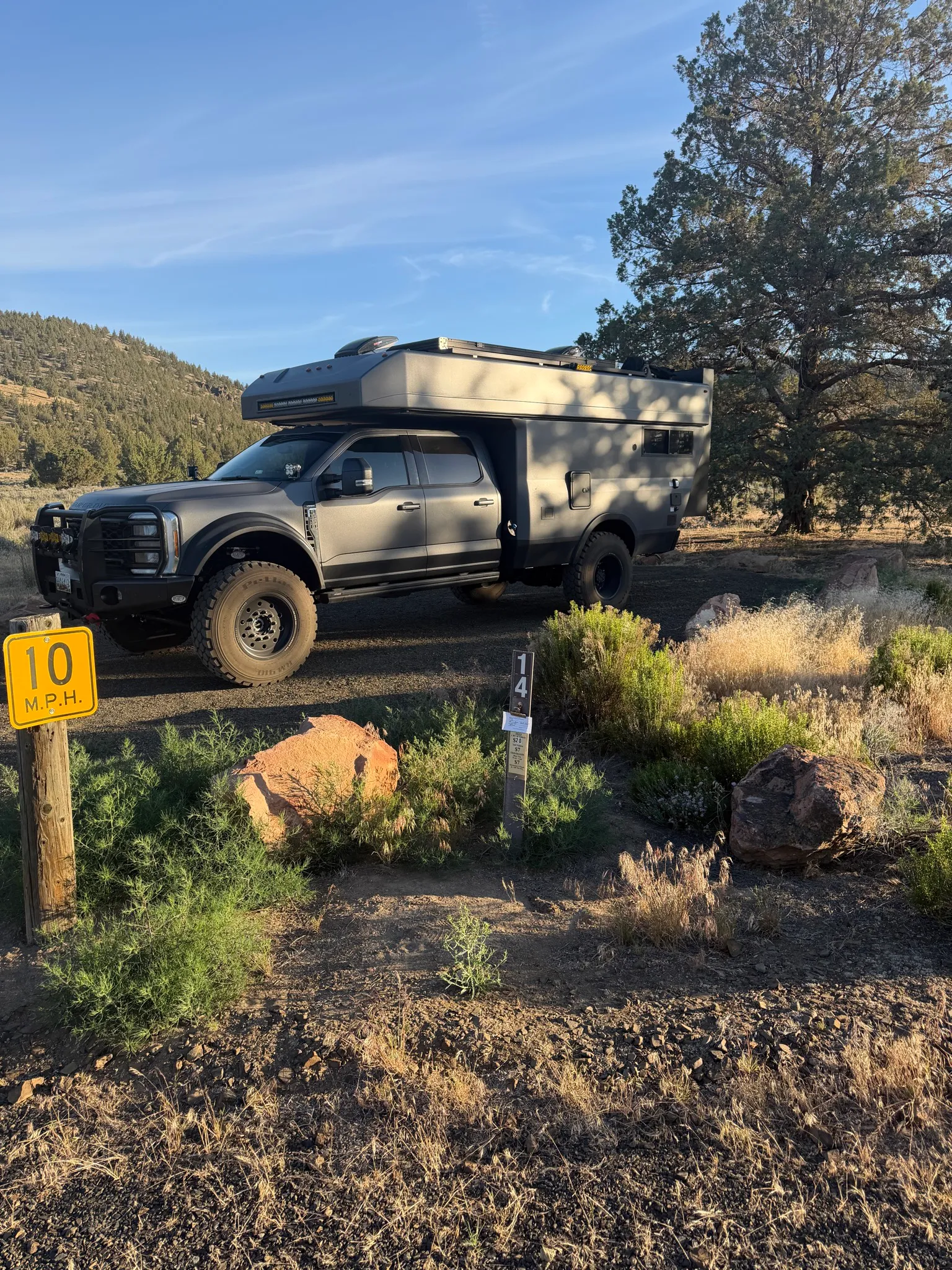
Van owners get asked how tall their van is. Truck camper owners get asked something harder: what does the whole thing weigh, and is the truck under it rated to carry that?
Most people cannot answer. Not because they built badly, but because the answer lives across three different stickers and a brochure, and nobody adds them up until something feels wrong on a downhill.
Truck campers are the one rig category where the specs are not trivia. They are the difference between a legal, stable rig and one that is quietly over its rear axle rating on every trip. Here is the math, in the order it matters.
1. Payload Is the Whole Conversation
On a van, payload is a thing you should check. On a truck camper, payload is the constraint that decides which campers you may even consider.
Find the sticker on your driver door jamb that reads something like "The combined weight of occupants and cargo should never exceed X lbs." That number is your payload, and it is specific to your truck as it was built, not to the model. Two F-350s on the same lot can differ by several hundred pounds depending on cab, bed, drivetrain, and options. A crew cab diesel four-wheel drive gives up a serious amount of payload to the engine and the extra doors before you put anything in the bed.
Then start subtracting. Everything that is not the truck counts against that number:
- You and your passengers. Yes, really, that is what "occupants and cargo" means.
- The camper's wet weight, which is not the brochure number. More on that below.
- Tie-downs, a bed mat, a headache rack, aftermarket bumpers, a winch, a hitch receiver.
- Whatever is hanging off the back, since tongue weight from a boat or moto trailer lands on the truck, not the trailer's axle.
- Water, propane, batteries, tools, food, dogs, firewood, and the recovery gear you never unpack.
The thing people get wrong: airbags, upgraded springs, and heavier shocks improve how an overloaded truck rides and feels. They do not raise your GVWR, your GAWR, or your payload. Those are ratings, not suspension characteristics. A truck that rides level at 1,000 pounds over is still 1,000 pounds over.
Check both limits, because they fail in different order. GVWR is the most the whole loaded truck may weigh. Each axle also carries its own GAWR, and a truck camper puts nearly all of its mass behind the cab. It is common to sit comfortably under GVWR while the rear axle is over its rating, which is a tire and brake problem long before anyone writes you a ticket.
2. Dry Weight Is Marketing. Wet Weight Is Yours.
A camper's published dry weight is the unit as it left the line with nothing in it. Depending on the builder it may exclude the batteries, the air conditioner, the generator, the awning, the solar, and every option you actually ordered.
Wet weight is dry weight plus the things that make it a camper you can sleep in. Two of those dominate:
- Water weighs 8.3 pounds per gallon. A 40-gallon fresh tank is roughly 330 pounds. Fill fresh, grey, and a water heater and you can clear 500 pounds of liquid before you pack a single duffel.
- Propane runs about 4.2 pounds per gallon, and the steel bottle it lives in is not light either.
Then add batteries, which is where modern builds get heavy fast, plus your gear. The honest way to find your real number is to stop calculating and go weigh it. A CAT scale at a truck stop costs a few dollars and gives you steer axle, drive axle, and gross weight in about five minutes. Do it loaded the way you actually travel, with full water, because that is the rig you drive.
Weigh it twice if you can: once with tanks full, once nearly empty. The difference is the single easiest lever you have. Choosing to travel with a quarter tank of fresh water and fill near camp is worth more than most weight-saving purchases.
| Number | Where to find it |
|---|---|
| Truck payload, GVWR, GAWR front and rear, tire size and pressures | Driver door jamb stickers |
| Camper dry weight, and what the builder excluded from it | Builder spec sheet or the label inside a cabinet door |
| Camper center of gravity | Marked on the camper's exterior sidewall by most builders |
| True loaded weight, per axle | CAT scale at a truck stop, tanks full |
| Loaded height, overhang, departure angle | Tape measure, camper mounted, level ground |
3. Center of Gravity and Tie-Downs
Where the weight sits
Most builders mark a center of gravity point on the side of the camper. Loaded correctly, that mark sits ahead of your rear axle centerline. Behind it, the camper starts levering weight off the front wheels, and the truck gets vague in the steering and light in exactly the moment you want it planted.
Know your CG location, know where your rear axle is, and know which way your particular loadout pushes the balance. A generator in the rear basement and a spare tire on the back bumper both work against you here.
How it is attached
Frame-mounted tie-downs carry load into the truck's frame. Bed-mounted systems carry it into sheet metal that was never designed for it. Write down which system you have, the turnbuckle type, and the torque or tension the manufacturer specifies.
Then note the habit, not just the spec: tie-downs need a look before every travel day. Turnbuckles back off, and the failure mode is not subtle.
4. Height, Length, and What Hangs Off the Back
Measure your loaded height with the camper mounted and the tanks full, since water settles the suspension. Find the true highest point, usually an air conditioner shroud, a roof rack, or a raised roof latch, and measure straight down to the pavement. Add a few inches of margin and write it in feet and inches on tape stuck to your visor.
Truck campers sit tall. Many loaded rigs land between eleven and thirteen feet, which puts you in a completely different world from a van. Urban parking structures commonly post six and a half to seven feet, so those are simply out. Drive-throughs, older tunnels, and tree-lined forest roads all become decisions you make in advance rather than at the last second.
Length matters at the campsite, and overhang matters on the trail. Your rear overhang sets your departure angle, which is what scrapes when you drop off a ledge or crest a steep approach. Crawl under and find your actual lowest point too. It is often a step, a hitch receiver, or a tank skid rather than the differential.
Two more worth having: your width with the mirrors out, and whether your camper's slide or roof lift changes any of these numbers. A pop-up that travels at eight feet and camps at eleven has two heights, and only one of them keeps you out of trouble.
5. Power, Water, and Heat
The systems side of a truck camper works like any other rig, with one twist: everything you add here comes straight out of payload, so the tradeoffs are sharper.
For power, record battery capacity in amp hours and your system voltage, because amp hours only compare fairly within the same voltage. 100 Ah at 12 volts holds about 1,200 watt hours; the same label at 24 volts holds about 2,400. Then note chemistry, since lead acid and AGM banks want you to use roughly the top half while lithium iron phosphate tolerates much deeper daily use. Add your inverter's continuous and surge watts, your solar array watts, and your DC-DC or alternator charging amps.
For water, write fresh, grey, and black capacity in gallons, plus your toilet type. Cassette, dry flush, and composting heads all change where you can legally stop and how often. Fresh capacity gets the attention, but grey usually ends the stay, and in a truck camper both tanks are small enough that the math is short.
For heat, record type, output in BTU, and fuel source. Combustion heaters care about elevation, and some need a high-altitude setting to burn cleanly up high. Our guide to van heating systems covers the categories, and the physics does not change because the box is on a truck bed.
Also record tire load range and date code on both truck and, if you tow, trailer. Load range matters enormously on a rig this rear-heavy, and rubber ages on a calendar rather than an odometer. The four-digit sidewall code gives you week and year of manufacture.
Keep These Numbers Somewhere You Can Reach Them
A spec sheet in your email is barely better than no spec sheet. The point is reaching the number while you are standing in a hardware store aisle, eyeing a low tunnel, or deciding whether to fill the fresh tank before a climb.
Grover keeps that sheet inside the app. The Rig button opens Rig Hub, and the Specs tile holds a sheet across eight sections, from Vehicle Details and Dimensions through Power, Water, Climate, Kitchen, Exterior and Recovery, and Custom Equipment. Fill in what applies to a truck camper and skip what does not. The tile shows how many of the eight have something in them, which is usually the nudge it takes to finish.
Your rig assistant reads that sheet on every answer, so a fuller sheet means advice about your truck and your camper instead of trucks and campers in general. Ask about tire pressure with your load range and axle weights recorded and you get a different quality of answer than the same question asked cold.
If you bought from a builder, open your spec sheet before you assume it is blank. Grover falls back to your builder's template for the rig you own, so a lot of it may already be filled in with their configuration. That is a genuinely good baseline, written by the people who built the thing. Rossmonster owners, for instance, start out looking at the numbers for the F-250 and F-350 platform their Baja builds sit on. Anything you add on top is what makes it yours.
And it pays off immediately. Every time you save the sheet, Grover re-runs the match against the documents available for your rig, so new manuals turn up under Suggested in your Glovebox on their own. Confirm the ones you want and your assistant starts answering from them too. Add your real tank sizes and battery capacity and you have changed what documentation Grover puts in front of you, not just what it knows.
Our walkthrough of Rig Hub covers what lives behind each tile, and the van build specs guide goes deeper on the power and water sections if your camper is plumbed and wired like a conversion.
Frequently Asked Questions
How much payload do I need for a truck camper?
More than the camper's dry weight, which is the mistake that starts most of these conversations. Take the camper's wet weight with your options, then add passengers, tie-downs, accessories, water, propane, and gear. Compare the total to the payload number on your driver door jamb sticker, and check your rear axle GAWR separately, since a truck camper loads the rear axle hardest.
What is the difference between dry weight and wet weight?
Dry weight is the camper empty and often without the options you ordered. Wet weight adds water, propane, batteries, and equipment. Water alone runs 8.3 pounds per gallon, so a full fresh tank can add several hundred pounds. Wet weight is the only number that describes the rig you actually drive.
Do airbags increase my truck's payload?
No. Airbags and heavier springs change how the truck rides and how level it sits. GVWR, GAWR, and payload are ratings set by the manufacturer and they do not move. A level, comfortable, overloaded truck is still overloaded.
How tall is a truck camper on a pickup?
Measure yours rather than looking it up, because it depends on the truck, the tires, and what is on the roof. Many loaded rigs land between eleven and thirteen feet. Measure with the camper mounted and tanks full, find the true highest point, add a few inches of margin, and write it on your visor. If you have a pop-up, record both the travel height and the camped height.
Where is the center of gravity on a truck camper?
Most builders mark it on the exterior sidewall. Loaded properly, that mark sits ahead of your rear axle centerline. Behind the axle, the camper levers weight off the front wheels and the truck starts handling badly, especially in crosswinds and on descents.
Give it an afternoon. Door jamb stickers, a tape measure, the label inside your camper's cabinet, and a trip to a scale with full tanks. You will end up with a rig you can describe in numbers instead of adjectives, which is the whole point.
Ready to put your rig's numbers in one place?
Grover gives your truck camper a spec sheet, then uses it to make answers about weight, power, water, and tires specific to what you actually built or bought.