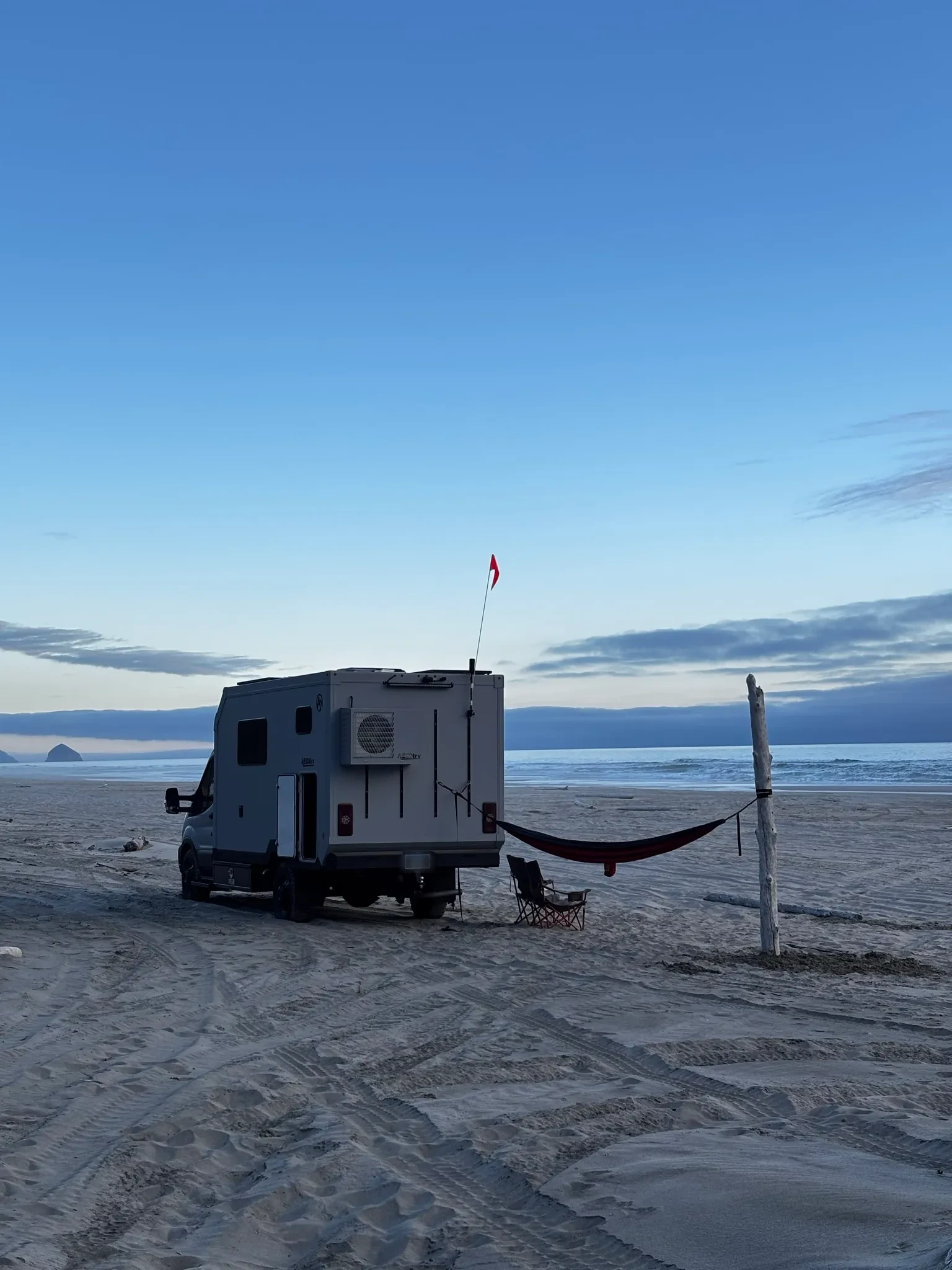
A Class C is two vehicles that were introduced to each other at a factory. Underneath is a cutaway chassis built by Ford, Ram, or Chevrolet. On top is a house built by somebody else entirely. Your specs live in both places, and the two sets rarely appear on the same piece of paper.
That split is why Class C owners can drive for years without knowing the one number that governs how much they can pack. It is printed on a label near the driver's seat or inside a cabinet, and it is not GVWR.
1. Cargo Carrying Capacity, the Number Nobody Reads
Look for the federal weight label, usually a yellow or white sticker near the driver's seat, in a cabinet, or inside a wardrobe door. It carries GVWR, axle ratings, and a line for cargo carrying capacity, sometimes labeled CCC or the newer OCCC, for occupant and cargo carrying capacity.
Here is why that number is small, and why it surprises people. It is what remains after the builder subtracts, from GVWR:
- The unloaded vehicle weight, meaning the coach as built with its installed equipment
- A full tank of fresh water, including the water heater
- A full load of propane
- An allowance for every designated sleeping position, standardized at 154 pounds each
So on a coach that sleeps six, roughly 924 pounds is already reserved for people before you load a single camp chair. What is left is your real cargo budget, and on a lot of Class C coaches it lands lower than owners expect. Add a generator, an awning upgrade, a bike rack, and a full basement, and it goes quickly.
The practical version: the only number you can trust is the one from a scale. A CAT scale at a truck stop costs a few dollars and gives you front axle, rear axle, and gross weight in about five minutes. Weigh it loaded the way you actually travel, with full tanks, then compare each axle to its own GAWR. A coach can sit under GVWR while one axle is over, and axles do not average.
Weigh corner to corner if you can find a scale that allows it. Class C coaches load unevenly by design, since the fresh tank, the generator, and the slide hardware are rarely on the same side, and one wheel position can be over while the axle total looks fine.
2. The Chassis Underneath
Know what you are driving, not just what you are living in. Most Class C coaches sit on a cutaway: a cab and frame delivered to the builder with nothing behind the seats. Common ones are the Ford E-Series, the Ford Transit, and the Ram ProMaster, and heavier coaches move up to an F-450, F-550, or E-450 style chassis with dual rear wheels.
Record year, make, chassis model, wheelbase, engine, fuel type, and whether you have single or dual rear wheels. That set determines almost everything practical: which shop can service you, what your fuel range is, how the coach behaves in crosswinds, and what your tire options are.
Two chassis notes worth writing down now rather than later:
- Fuel capacity and real-world range. Published tank size minus the reserve you refuse to dip into is your actual planning number, and it shrinks on grades and in headwinds.
- Tire size, load range, pressures, and date code. This matters more on an RV than on a daily driver, because coaches sit still for long stretches. Tires age out on a calendar long before they wear out. The four-digit code on the sidewall gives you week and year of manufacture, and the pressures on the chassis sticker are cold pressures for a loaded coach.
3. Length, Height, and the Overhang Behind You
Height, measured rather than looked up
Published height describes the coach without your additions. Measure yours on level ground with the tanks full, find the true highest point, usually an air conditioner shroud, a satellite dome, or a roof rack, and measure straight down to the pavement. Add a few inches of margin, then write it in feet and inches on tape stuck to the driver's visor.
Class C coaches commonly land somewhere between eleven and thirteen feet loaded, which rules out most urban parking structures, many older tunnels, and a lot of tree cover on forest roads. Some national parks post combined height and width restrictions on specific tunnels and require a paid escort, so check the park's road restrictions page before you commit to a route.
Length, and where it stops being welcome
Know your bumper-to-bumper length. Campgrounds publish a maximum vehicle length per site, and in older national park and state park loops that limit is often well under thirty feet. If you tow, know your combined length too, since some sites and many switchback roads care about the whole train.
Overhang, the Class C signature
Two overhangs define how a Class C drives. The cabover bunk hangs out front, which is why low branches and gas station canopies find your roof before you expect them. The rear overhang behind the axle sets your departure angle, which is what scrapes on a steep driveway or a dip at a campground entrance. Long rear overhang also amplifies tail swing in tight turns, and that is what finds the fuel pump bollard.
Measure both. Then crawl under and find your actual lowest point, usually a step, a hitch receiver, or a tank skid rather than the differential.
| Number | Where to find it |
|---|---|
| GVWR, GAWR front and rear, cargo carrying capacity | Federal weight label near the driver's seat or in a cabinet |
| Chassis details, tire size, cold pressures | Driver door jamb sticker on the cab |
| Tow rating, hitch rating, GCWR | Chassis manufacturer documentation and the hitch label itself |
| True loaded weight, per axle | CAT scale at a truck stop, tanks full |
| Tank capacities, generator model, appliance models | Coach builder's spec sheet and the labels on the equipment |
| Loaded height, length, overhangs | Tape measure, level ground, tanks full |
4. Towing, and the Three Ratings People Confuse
If you plan to pull a car, a boat, or a cargo trailer, three separate limits apply and the smallest one wins:
- Tow rating. The most the chassis is rated to pull.
- Hitch rating. Stamped on the receiver, and often lower than the tow rating. It has a tongue weight limit too.
- GCWR, gross combined weight rating. The most the coach and whatever it tows may weigh together. This is the one that actually binds most Class C setups, because a coach loaded near its own GVWR has very little combined headroom left.
Write down all three, then note that tongue weight lands on your coach's rear axle, not on the trailer's. That is the same axle already carrying your generator, your fresh tank, and your basement storage.
5. Tanks, Power, and the Generator
Record fresh, grey, and black capacity in gallons. Grey usually ends the stay, not fresh, and on a Class C the black tank often runs out first because a residential-style flush uses more water than a cassette. Knowing which one fills first is the difference between planning a dump stop and needing one.
Water weighs 8.3 pounds per gallon, which loops straight back to your cargo budget. A 50-gallon fresh tank is more than 400 pounds. Traveling with a quarter tank and filling near camp is often the single easiest weight decision available to you.
For power, note battery capacity in amp hours with your system voltage, chemistry, inverter continuous and surge watts, solar array watts, and your shore power rating, typically 30 or 50 amps. That shore rating decides which campground pedestals work without an adapter and whether you can run air conditioning and a microwave at the same time.
Then the generator, which is the Class C system most likely to be neglected. Record the make, model, rated output in watts, its fuel source, and the hour meter reading. Generators want to be run under load periodically, and the maintenance interval is measured in hours, not months. Write down when you last serviced it, because nobody remembers.
Also record heater type and BTU output, air conditioner BTU and current draw, propane capacity, and where your carbon monoxide and propane detectors are mounted along with when you last tested them. Our guide to van heating systems covers the heat categories, and the tradeoffs carry over to a coach.
Keep These Numbers Somewhere You Can Reach Them
All of this is useless in a filing cabinet. The point is having the number when you are looking at a posted clearance, deciding whether to fill the fresh tank before a mountain pass, or on the phone with a parts counter.
Grover keeps that sheet inside the app. The Rig button opens Rig Hub, and the Specs tile holds a sheet across eight sections covering vehicle details, dimensions and capacity, power, water, climate, kitchen and living, exterior and recovery, and custom equipment. Fill in what applies to a coach and leave the rest. The tile shows how many of the eight have something in them, which is usually what gets people to finish.
Your rig assistant reads that sheet on every answer. Ask about a tunnel, a tire pressure, or a generator fault with your real numbers recorded and the answer is about your coach rather than motorhomes in general.
If you bought from a builder, check your spec sheet before assuming it is empty. Grover falls back to your builder's template for the coach you own, so much of it may arrive already filled in with their configuration. That is a real head start from the people who built it. AEONrv owners, for instance, start out looking at the numbers for the one-ton Transit cutaway chassis their coaches are built on. What you add on top is what makes it your coach rather than the model.
The payoff is immediate. Saving the sheet makes Grover re-run the match against the documents available for your rig, so new manuals appear under Suggested in your Glovebox on their own. Confirm the ones you want and your assistant answers from them too. Put in your generator model and your real tank sizes and you have changed the paperwork Grover hands you, not just the numbers it knows.
Our walkthrough of Rig Hub covers each tile, the truck camper guide is the sibling post if you are weighing a switch, and the van build specs guide goes deeper on electrical and water.
Frequently Asked Questions
What is cargo carrying capacity on a Class C?
It is what remains of your GVWR after the builder subtracts the coach's unloaded weight, a full fresh water tank, a full propane load, and a standardized 154-pound allowance for every designated sleeping position. It appears on the federal weight label near the driver's seat or inside a cabinet. It is a much smaller number than GVWR and it is the one that limits what you can pack.
How tall is a Class C RV?
Most land between eleven and thirteen feet loaded, but measure yours instead of trusting a brochure, since air conditioners, satellite domes, and racks all add height. Measure on level ground with tanks full, add a few inches of margin, and write it on your visor. Then check park and tunnel restrictions along your route rather than at the entrance.
What chassis is a Class C built on?
A cutaway, meaning a cab and frame delivered to the coach builder with nothing behind the seats. Ford E-Series, Ford Transit, and Ram ProMaster are common, and heavier coaches use chassis like the E-450, F-450, or F-550 with dual rear wheels. Your chassis determines service options, fuel range, tire choices, and how the coach handles.
Can I tow a car behind a Class C?
Often yes, but three limits apply and the smallest governs: the chassis tow rating, the hitch rating stamped on the receiver, and GCWR, the maximum combined weight of coach and trailer. GCWR is usually the binding one, because a coach loaded near its own GVWR has little combined headroom left. Tongue weight also lands on your already-loaded rear axle.
Why do RV tires need replacing before they wear out?
Because coaches sit. Rubber ages on a calendar rather than an odometer, so an RV tire can reach the end of its service life with plenty of tread left. Read the four-digit code on the sidewall for week and year of manufacture, and run the cold pressures listed for your loaded weight.
Set aside an afternoon. The weight label, the cab door jamb, the hitch receiver, a tape measure, and a trip to a scale with full tanks. You will finish with a coach you can describe in numbers, which is what turns generic advice into advice that fits.
Ready to put your coach's numbers in one place?
Grover gives your Class C a spec sheet, then uses it to make answers about weight, clearance, power, and water specific to your coach instead of generic.